Most lawyers are not short of AI tools. What they are short of is clarity on which tool to use, for which task, and how to make it work reliably in practice. That was the problem this session at Law Society set out to solve.
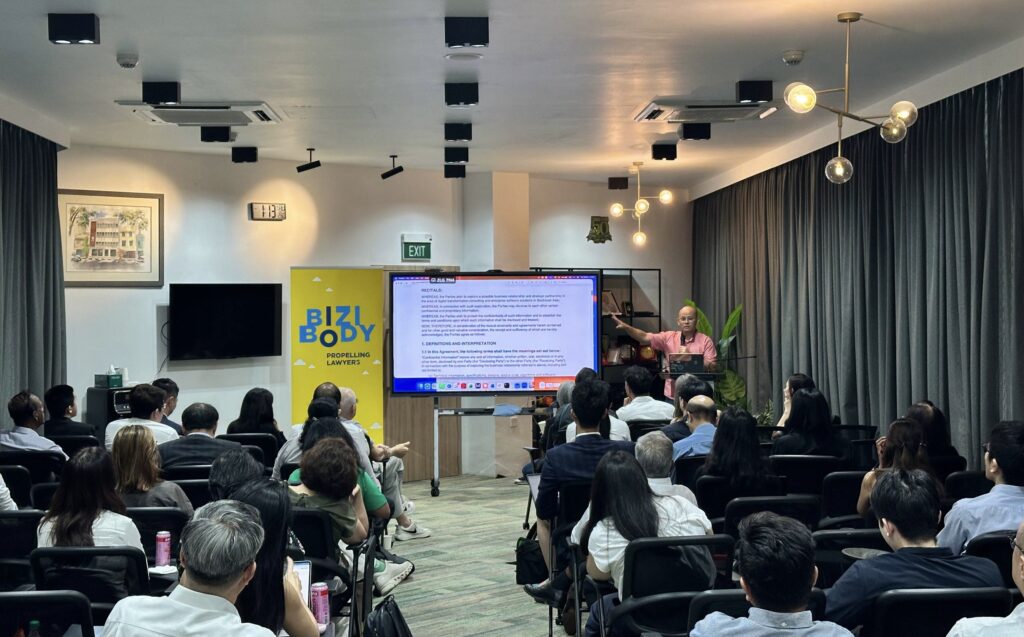
On 26 March 2026, Bizibody Technology partnered with the Law Society of Singapore to host a lunchtime session titled AI Tools for Everyday Legal Tasks. Designed as a practical show-and-tell rather than a lecture, the session walked attendees through real workflows across the AI tools most relevant to legal practice today.
The audience came with genuine questions. A quick poll at the start surfaced the AI tools participants were already using. The answers shaped the energy of the room for the rest of the session. Structure your inputs, be deliberate with your prompts, and treat AI as part of a system rather than a standalone shortcut.
Right Tool for the Right Workflow
The gap is not access. It is application. Using AI well means thinking in terms of specific workflows rather than generic usage, structuring your data and communications deliberately, and understanding that prompt engineering is not a technical skill reserved for developers. It is a professional skill, and one that compounds quickly once it clicks.
Serena Lim, Founder and Managing Director of Bizibody Technology, anchored this framing with 26 years of perspective on how Singapore law firms adopt technology. The pattern is consistent: the firms that get the most out of new tools are the ones that invest in understanding how the tool fits their work, not just what the tool can do in isolation.
Microsoft 365 Copilot and Google Gemini
Lawson Sim and Zulaikha Shariff covered the productivity layer that most firms already have within reach. For Copilot, the focus was on the tasks that quietly consume hours every week: drafting affidavits and letters of engagement from templates, managing email threads, preparing for meetings, capturing notes and converting them into follow-up actions. Copilot’s integration with Power Automate was also touched on, with examples including evidence review, chronology building, and a workflow for capturing contact information into a structured database.
Gemini’s strength in handling large, complex document sets made it a natural fit for litigation support. For firms managing document-heavy matters, Gemini’s multimodal capabilities offer a practical edge in trial preparation.
Claude and the Agentic Frontier
The segment that drew the most attention was delivered by Haojun See, a consultant at Bizibody Technology and founder of On The Ground, a specialist consultancy helping professionals move beyond surface-level AI use.
Haojun focused on Claude and the timing is not incidental. Claude has emerged as one of the most capable models available today, with reasoning depth that handles complexity that simpler tools struggle with. For legal work, this matters. Contracts are dense, obligations are nested, and the cost of missing something is real. Claude’s ability to hold large volumes of material in context and reason across them coherently makes it genuinely useful for the kind of analytical work lawyers do, not just the administrative layer.
Haojun demonstrated how Claude Cowork and Claude Code can be used to interrogate entire document bundles, cross-reference contracts at scale, extract key obligations from lengthy agreements, and surface critical issues from due diligence materials in a fraction of the time manual review requires. Equally important, he showed how outputs and repeatable workflows can be shared across a team. That means when one person develops a reliable approach, the whole firm benefits.
In Singapore, the direction is clear: to move from individual productivity tools to agentic workflows that can handle multi-step, high-stakes tasks with minimal manual input at each stage. Claude is at the leading edge of that shift.
Yet, that shift will not happen overnight. The firms that will benefit most from agentic AI are those that have already done the groundwork today: clear workflows, trained people, and a culture of deliberate, responsible AI use.